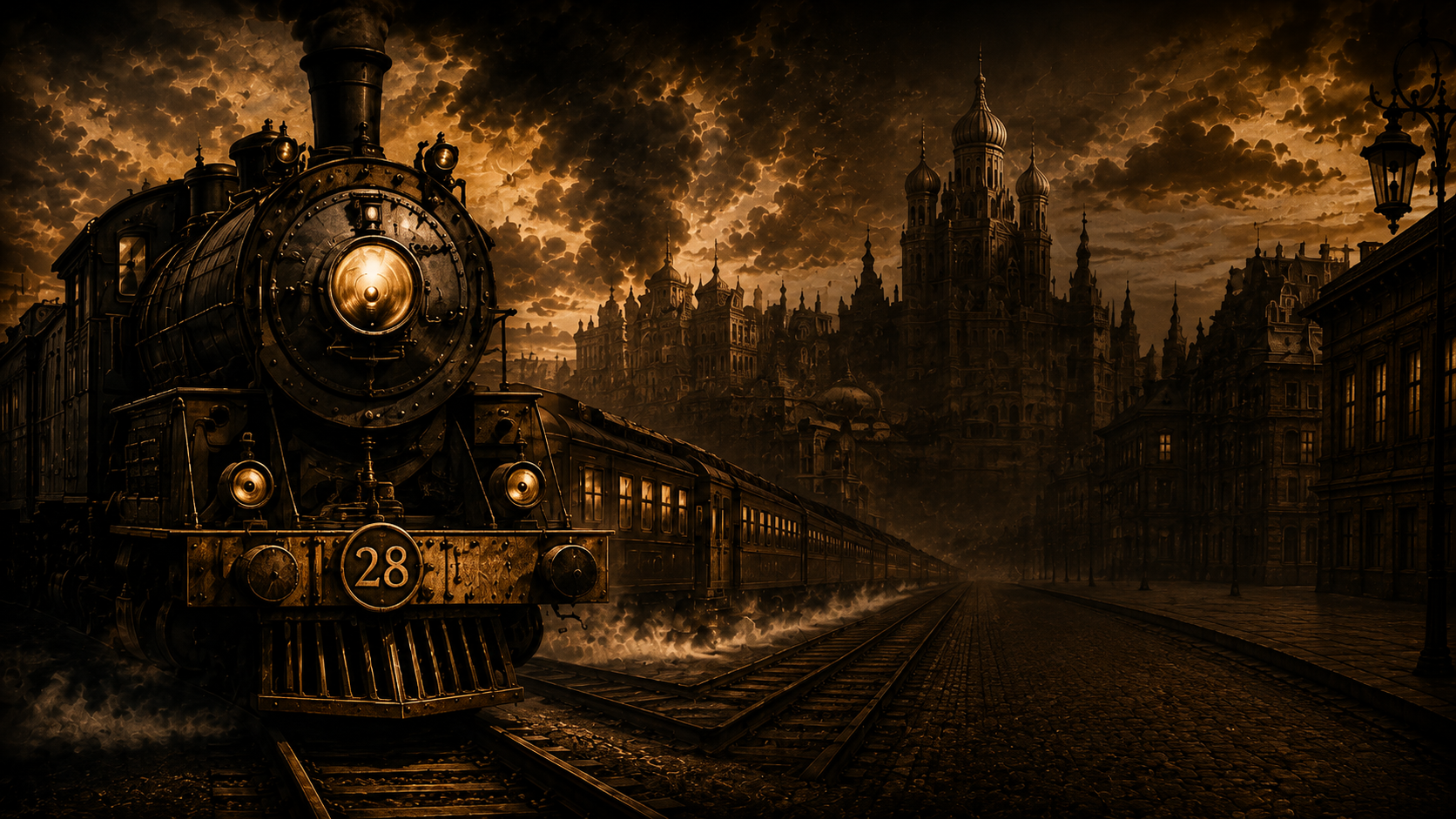
Special Train #28
By Presidential Decree
The Train That Carries the Mystery
Every great historical investigation has a defining moment.
For History Had Eyes, that moment begins aboard Special Train #28.
According to the recorded testimony of American Army Private Martin Van Buren Hutson, Special Train #28 was far more than a military railway operation. Disguised as an American Red Cross humanitarian relief train, it allegedly carried supplies, military personnel, diplomatic officials and, according to Martin's account, Tsar Nicholas II and other surviving Romanov family members - across thousands of miles of war-torn Siberia toward Harbin, China.
The train represented more than transportation. It was a carefully coordinated Allied operation moving through one of the world's most dangerous regions in the aftermath of World War I and during the Russian Civil War. Every stop, every transfer, and every mile traveled depended upon secrecy, military discipline, and international cooperation.
For two weeks, Martin traveled aboard this remarkable train. Decades later, he carefully recorded his memories of the journey describing its passengers, its purpose, its dangers, and the extraordinary precautions taken to conceal its mission.
Years after hearing Martin's story, author Ben Everidge began searching for documentary evidence that such a train had existed. What began as skepticism gradually evolved into an investigation through the National Archives, military records, diplomatic correspondence, and American Expeditionary Forces documents. Among those discoveries was evidence that Special Train #28 was indeed operating in Siberia at the time Martin described, supporting at least one important element of his recollection.
Whether every detail unfolded exactly as Martin remembered remains the subject of ongoing historical investigation. Yet the existence of Special Train #28 transformed his story from family lore into a question worthy of serious research.
This section follows the route of the train, introduces the people connected to its mission, examines the historical records surrounding its operation, and explores why one railway journey has become the centerpiece of a century-old mystery.
"Some mysteries begin with a witness. Others begin with a footnote. Special Train #28 began with both."
Why the Significance of #28
"Why would an ordinary military train become one of the most intriguing mysteries of the twentieth century?"
Sometimes history hides its greatest secrets in the footnotes.
One of the questions readers ask most often after reading Rescuing Nicholas: The Secret Mission to Save the Tsar is remarkably simple:
Why was it called Special Train #28?
When Martin Van Buren Hutson first shared his story with me in 1970, he never hesitated when describing the train. He remembered its designation clearly: Special Train #28.
Years later, when I began researching his account, I searched military records, American Expeditionary Forces reports, and archival collections looking for any evidence that such a train had existed.
At first, I found nothing.
In fact, many of the records relating to special train operations in Siberia had reportedly been destroyed after World War I. It appeared that the paper trail had disappeared.
Fortunately, I had learned an important lesson while serving as a congressional staff member on Capitol Hill.
When major documents are missing...
Read the footnotes.
Footnotes often preserve the small references that larger reports overlook. They reveal sources, cross-references, and operational details that can survive even when the principal records have been lost.
That lesson proved invaluable.
Buried in an archival footnote was a reference that immediately captured my attention:
Special Train #28.
For the first time, Martin's memory of the train was no longer simply family testimony. There was documentary evidence that a Special Train #28 was operating in Siberia during the period he described.
For me, that discovery marked a turning point.
The investigation had moved beyond recollection and into the historical record.
Why the designation "28"?
One possible explanation explored throughout this investigation is that the train's designation reflected authorization by President Woodrow Wilson, the 28th President of the United States, whose administration directed the American Expeditionary Forces' intervention in Siberia. While the surviving records do not explicitly explain the numbering system, the coincidence has become one of the intriguing questions surrounding the mission and one that invites further research.
Whether that interpretation ultimately proves correct remains part of the broader historical inquiry.
What is not in dispute is that finding the archival reference to Special Train #28 transformed the investigation. A story that began around my grandmother's living room was now anchored, at least in part, by documentary evidence.
Sometimes history speaks loudly through famous speeches and presidential papers.
Sometimes it whispers from the bottom of the page.
And sometimes, the most important clue is waiting in a footnote no one thought to read.
"History does not always disappear. Sometimes it simply waits for someone willing to read the footnotes."
Additional evidence found:
“Train 28 arrived right on time at 6:00 am”
“RRSC Chairman Stevens arrived Harbin Yard”
“Special trains were those trains that carried RRSC executives or Allied Forces officers and State Department personnel”