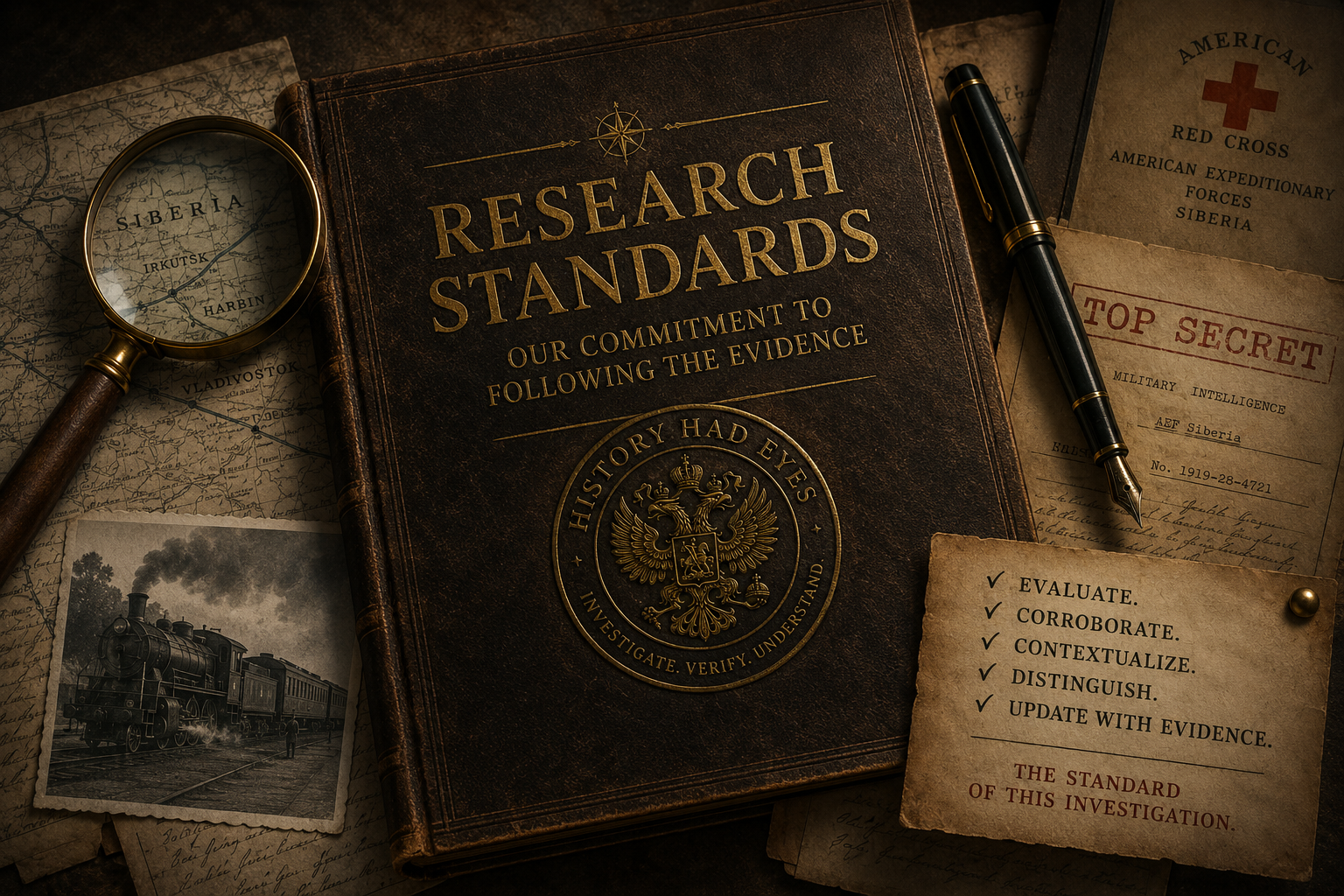
Our Commitment to Research Excellence
How We Evaluate Evidence
The Research Standards of History Had Eyes
History Had Eyes begins with an extraordinary story.
For decades, Martin Van Buren Hutson maintained that, while serving as an American soldier in Siberia following World War I, he encountered and traveled with a living Nicholas II at a time when accepted history holds that the former Russian emperor was already dead.
That claim deserves neither automatic acceptance nor automatic dismissal.
It deserves investigation.
That distinction lies at the heart of History Had Eyes.
Our purpose is not to replace one predetermined historical narrative with another. Nor is it to ask viewers, readers, researchers, or historians to accept conclusions simply because we find them compelling.
Our purpose is to ask questions, locate evidence, examine competing explanations, distinguish what is known from what is inferred, and allow the status of the investigation to change when - and only when - the evidence warrants it.
That requires standards.
This article explains ours.
Start With the Accepted History
Serious historical investigation should begin by understanding the prevailing historical record, not by pretending it does not exist.
The accepted historical account holds that Nicholas II, Alexandra, their five children, and members of their household were killed at Ekaterinburg in July 1918. Subsequent investigations, the discovery of human remains, forensic examinations, DNA testing, archival research, eyewitness accounts, and decades of historical scholarship have contributed to that conclusion.
History Had Eyes does not erase that body of evidence merely because Martin Hutson told a different story.
Instead, we ask a narrower and more difficult question:
Does the evidence surrounding Martin Hutson's account, and other evidence uncovered during this investigation, justify continued examination of the accepted historical conclusion?
That is a very different proposition from declaring that history is wrong.
It places the burden where it belongs: on the evidence.
Five Things That Must Not Be Confused
One of the greatest dangers in historical investigation is allowing different kinds of information to become indistinguishable.
A documented fact is not the same as a recollection.
A recollection is not the same as corroboration.
Corroboration is not necessarily proof.
An interpretation is not a fact.
And an unanswered question is not evidence that a preferred explanation must be true.
Throughout History Had Eyes, we therefore seek to distinguish among five important categories.
1. Established Fact
An established fact is something supported sufficiently by reliable historical evidence that, for purposes of our investigation, we have no material reason presently to dispute it.
These might include dates, military assignments, documented locations, government actions, known relationships, troop movements, or other matters supported by credible records.
"Established" does not mean that historical scholarship can never change.
History changes when new evidence emerges.
It means that the available evidence currently provides a sufficiently strong foundation for us to treat the matter as established unless credible contrary evidence emerges.
2. Documented Evidence
Documented evidence is something preserved in a source that can be identified, examined, evaluated, and - where possible - independently verified.
Examples can include military records, diplomatic correspondence, government memoranda, intelligence reports, railway records, contemporary newspapers, photographs, diaries, letters, maps, archival files, and other primary or secondary materials.
But the existence of a document does not automatically establish that everything contained within it is true.
Documents have authors.
Authors have perspectives.
Reports can contain mistakes. Intelligence can be incomplete. Memories can be inaccurate. Governments can misunderstand events. Newspapers can repeat rumors.
Consequently, we ask additional questions:
Who created the document?
When was it created?
Why was it created?
Where has it been preserved?
Can its provenance be established?
Was the author in a position to know what the document claims?
Does other evidence corroborate or contradict it?
A document is evidence.
Its meaning still requires evaluation.
3. Witness Testimony
Martin Hutson's account makes this category especially important.
Witness testimony can be extraordinarily valuable historical evidence. Much of what humanity knows about the past depends, at least partly, upon people describing what they saw, heard, experienced, or were told.
But testimony must be treated carefully.
When examining a witness account, we consider questions such as proximity to the event, the passage of time before the account was recorded, consistency across retellings, possible corroboration, possible contradiction, motive, opportunity, and whether independently documented circumstances make the account possible.
This leads to an essential distinction in the History Had Eyes investigation:
Evidence establishing that Martin Hutson said something is not automatically evidence establishing that what Martin described occurred exactly as he remembered it.
Those are two separate propositions.
Our task is to determine whether independent evidence can corroborate important elements of his account.
That is one of the central purposes of this investigation.
4. Interpretation
Historical evidence rarely interprets itself.
Researchers must determine what documents, events, relationships, coincidences, absences, and contradictions might mean.
That process produces interpretation.
Interpretation is legitimate and necessary. But it must be identified as interpretation.
If several records place individuals in the same geographical area during the same period, for example, that may establish proximity. It does not automatically establish that they met.
If a government record suddenly becomes silent, that silence may be interesting. It does not automatically establish concealment.
If two apparently unrelated documents appear consistent with the same hypothesis, the relationship deserves investigation. It does not automatically establish causation.
History Had Eyes will sometimes propose interpretations of evidence.
When we do, our goal is to make clear where the underlying evidence ends and our reasoning begins.
5. Unanswered Questions
Perhaps the most important category is the simplest:
We don't know.
There is nothing intellectually weak about that conclusion.
In fact, it can be one of the strongest conclusions an investigator reaches.
An unanswered question is not a blank space into which we may insert whatever explanation best fits our preferred theory.
It remains unanswered.
Some questions may eventually be resolved through additional archival research. Others may remain unresolved because records were destroyed, witnesses died, governments failed to preserve information, or the necessary evidence simply no longer exists.
History Had Eyes will identify important unanswered questions rather than conceal them.
They are not failures of the investigation.
They are part of the investigation.
Our Four Investigation Statuses
To make these distinctions easier for readers and researchers to understand, History Had Eyes uses four investigation statuses.
These statuses describe our present assessment of a specific proposition based upon the evidence currently available to us.
They are not permanent verdicts.
ESTABLISHED
The proposition is supported by sufficiently strong and reliable evidence that History Had Eyes presently has no material basis to dispute it.
New credible evidence can always require reconsideration, but the matter currently rests upon a strong evidentiary foundation.
SUPPORTED
Meaningful evidence supports the proposition, potentially including independent corroboration, but limitations, competing evidence, unanswered questions, or evidentiary gaps prevent us from treating it as established.
"Supported" should therefore never be read as "proven."
It means the evidence gives the proposition meaningful weight.
UNDER INVESTIGATION
Evidence, testimony, documentation, or circumstances raise a question substantial enough to warrant continued research, but the available evidence does not presently justify moving the proposition to Supported or Established.
This will be an important category throughout History Had Eyes.
It means:
There is something here worth investigating.
It does not mean:
We have determined that it happened.
UNRESOLVED
The available evidence is insufficient, materially conflicting, inaccessible, or otherwise inadequate to support a responsible conclusion.
An Unresolved designation may remain in place indefinitely.
We would rather leave a historical question unanswered than manufacture certainty the evidence does not provide.
Status Is Earned by Evidence
There is an important principle behind this system: Investigation status changes only when the evidence warrants it.
A compelling documentary does not change a status.
A persuasive argument does not change it.
A popular social-media post does not change it.
A family tradition does not change it.
A new hypothesis does not change it.
And our personal desire for an answer does not change it.
Evidence does.
A proposition might move from Under Investigation to Supported when meaningful independent corroboration is discovered.
A proposition might move from Supported to Established when the cumulative evidence becomes sufficiently strong.
But movement can occur in the opposite direction as well.
New evidence could cause something previously regarded as Supported to become Under Investigation, or Unresolved.
If evidence materially contradicts a History Had Eyes hypothesis, that evidence belongs in the investigation too.
Following the evidence means accepting the possibility that it may lead somewhere we did not expect.
Evidence That Challenges Our Hypothesis Matters
This principle deserves special emphasis.
History Had Eyes began because Martin Hutson's story raised questions about the accepted historical narrative.
That does not mean evidence supporting Martin receives preferential treatment.
Evidence challenging his account matters just as much.
The Romanov remains, DNA findings, contemporary accounts, Bolshevik records, subsequent investigations, historical scholarship, and other evidence supporting the accepted account must be examined seriously.
If we present evidence favoring one interpretation while withholding credible evidence pointing toward another, we are no longer investigating.
We are advocating.
History Had Eyes aspires to something more demanding.
Corroboration Matters
One of our most important research objectives is independent corroboration.
Suppose Martin described a person, place, train, military unit, date, or event decades ago.
Finding independent evidence that the person existed is useful.
Establishing that the person was in Siberia is more useful.
Establishing that the person was in the relevant location at the relevant time is more significant still.
But even then, the evidence must not be stretched beyond what it establishes.
This is how historical cases become stronger - not through one spectacular discovery, but through multiple independent pieces of evidence that begin to converge.
Conversely, contradictory evidence must also be weighed.
The objective is not accumulation.
It is corroboration, contradiction, context, and convergence.
Absence of Evidence Requires Special Care
Historical investigations frequently encounter missing records.
Documents disappear.
Archives contain gaps.
Records are destroyed.
Some intelligence activities were deliberately compartmentalized.
Other events simply were never documented.
But missing evidence presents a dangerous temptation.
The absence of a document cannot automatically be treated as evidence that the document was intentionally destroyed.
A gap in an archive does not prove a cover-up.
Government secrecy cannot be assumed simply because an answer cannot be found.
Sometimes the responsible conclusion is simply:
We have not found the evidence.
If additional evidence later changes that assessment, the investigation changes with it.
Intelligence Operations Present a Particular Challenge
The events examined by History Had Eyes occurred during an extraordinary period involving war, revolution, military intervention, diplomacy, intelligence activity, political instability, and rapidly changing alliances.
That environment requires special caution.
Successful intelligence and clandestine operations are often designed to conceal participants, objectives, movements, or outcomes. But that historical reality cannot become a universal explanation for missing evidence.
We cannot responsibly argue:
"There is no evidence because the operation was secret."
That reasoning would make the hypothesis impossible to test.
Instead, alleged secrecy itself must be investigated.
Are there indirect records?
Personnel movements?
Financial records?
Military orders?
Diplomatic communications?
Transportation records?
Later recollections?
Corroborating witnesses?
Unexplained but documented changes in behavior?
The possibility of secrecy can inform an investigation.
It cannot substitute for evidence.
Provenance and Chain of Custody
Evidence is only as useful as our ability to understand where it came from.
Whenever possible, History Had Eyes seeks to identify the provenance of significant evidence:
Where was it discovered?
Who created it?
Where has it been stored?
Is the original available?
Is the material a copy?
Has it been independently authenticated?
Has it been altered, translated, transcribed, or reproduced?
Can the chain between the original source and what viewers see today be reconstructed?
These questions become particularly important when examining photographs, forensic materials, alleged intelligence records, physical remains, later reproductions, and documents obtained outside established archival collections.
Separating Possibility From Probability
Another distinction matters enormously.
Something being possible does not make it probable.
Historical research frequently establishes that an event could have happened.
A person could have been somewhere.
A train could have taken a particular route.
A government could have undertaken an operation.
Two individuals could have met.
Those findings can be important because they may eliminate an impossibility.
But establishing possibility is only the beginning.
The next question is whether evidence demonstrates that the event probably - or actually - occurred.
History Had Eyes will seek to preserve that distinction throughout the investigation.
We Welcome Serious Challenges
A historical investigation becomes stronger when its assumptions are challenged.
We therefore welcome credible evidence, alternative interpretations, archival discoveries, corrections, and reasoned disagreement.
If you encounter evidence that supports an aspect of this investigation, we want to know about it.
If you encounter evidence that contradicts it, we want to know about that too.
The objective is not to win an argument.
The objective is to understand what happened.
That is a much higher standard.
A Living Investigation
History Had Eyes is being built differently from a finished historical book.
The documentary episodes will appear over time.
The Evidence Room will grow.
The Digital Research Vault will expand.
New documents will be added.
Additional archives will be explored.
Researchers may challenge our interpretations.
Members may identify new leads.
Educators and scholars may ask questions we have not considered.
And evidence may change our thinking.
That is intentional.
Visitors returning six months from now may encounter an investigation that looks different from the one they see today.
A question may have been answered.
Another may have emerged.
An interpretation may have strengthened.
Another may have weakened.
A status may have changed.
We will regard that not as inconsistency, but as evidence that the research process is working.
The Standard We Ask You to Hold Us To
History Had Eyes asks viewers to question history.
It is only fair that you question us as well.
Ask where our evidence came from.
Ask whether another interpretation is possible.
Ask whether testimony has been corroborated.
Ask what evidence contradicts our position.
Ask whether we have distinguished fact from inference.
Ask what remains unknown.
And ask whether we changed our conclusions when the evidence changed.
Those are precisely the questions we intend to ask ourselves.
Because the ultimate purpose of History Had Eyes is larger than determining what happened to one Russian emperor.
It is about something fundamental to historical inquiry:
How do we know what we think we know?
The answer cannot be that a story has been repeated for a century.
Nor can it be that an alternative story is fascinating.
The answer must rest upon evidence, and upon our willingness to follow that evidence even when it challenges what we hoped, expected, or previously believed we would find.
That is our research standard.
That is our commitment to our investigators.
And that is what we mean when we say: Follow the Evidence.