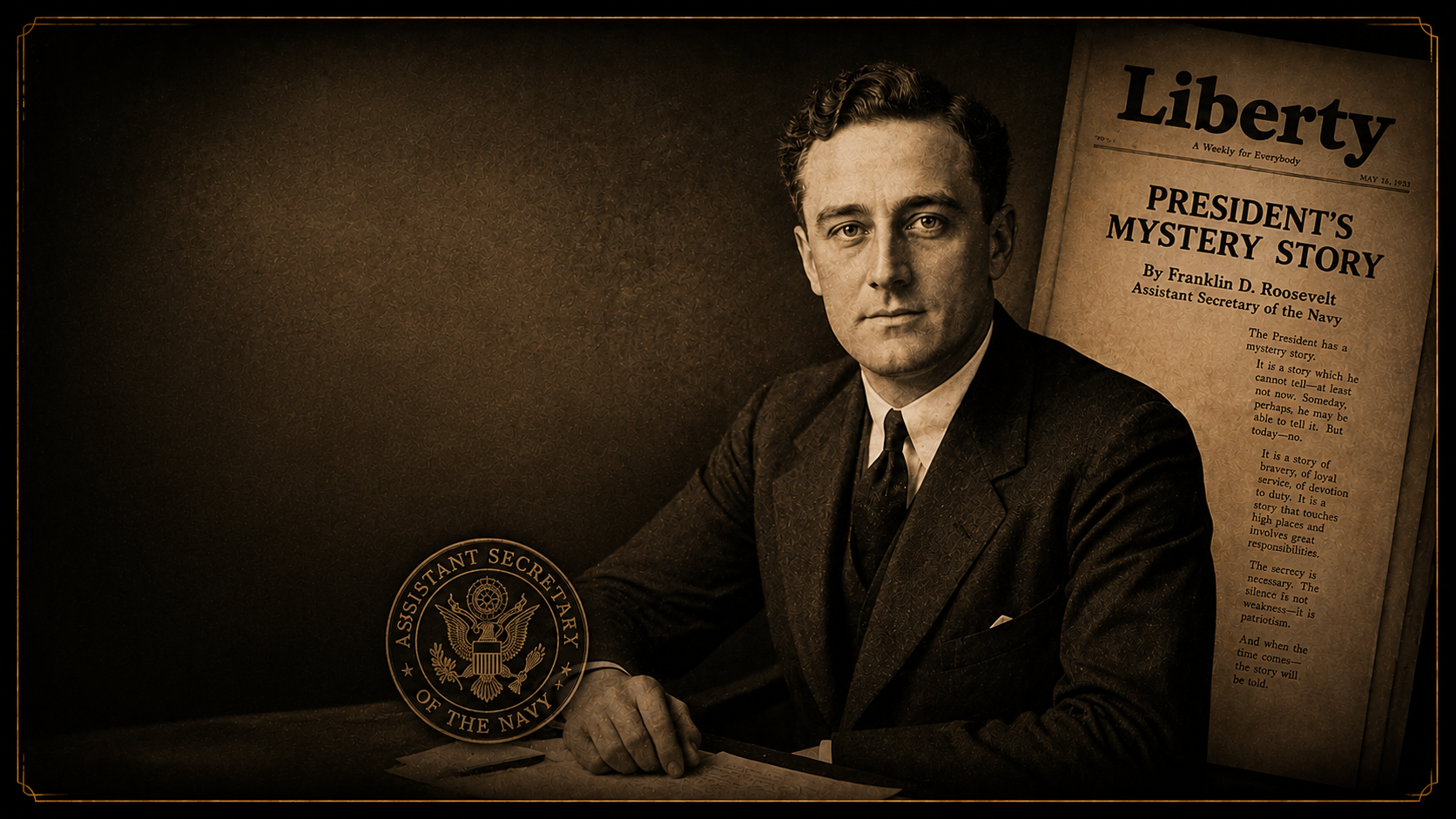
The President’s Mystery Story
Another Eyewitness?
FDR
For most Americans, Franklin Delano Roosevelt - FDR as America lovingly nicknamed him - is remembered as the president who led the nation through the Great Depression and the Second World War.
Long before he entered the White House, however, Roosevelt served as Assistant Secretary of the Navy under President Woodrow Wilson. During World War I and the turbulent years that followed, he helped oversee America's naval operations in the Pacific, including the movement of military assets between San Francisco and Vladivostok, Russia - the principal Allied sea route supporting the American Expeditionary Forces in Siberia.
That assignment placed Roosevelt within the broader military and diplomatic effort surrounding the Allied intervention in Siberia.
Years later, after becoming President of the United States, Roosevelt surprised many readers by writing a fictional mystery for Liberty Magazine entitled The President's Mystery Story. The story centered on a wealthy aristocrat who apparently dies, assumes a new identity, and vanishes into another life, leaving investigators struggling to uncover the truth behind his disappearance.
The story proved so popular that it was later adapted for the motion picture The President's Mystery.
For most readers, it was simply an entertaining mystery.
For students of the Romanov story, however, it raises an intriguing question.
Did Roosevelt's fictional plot draw upon memories of events he had witnessed, or learned about, as Assistant Secretary of the Navy during America's involvement in Siberia?
Historian Doris Kearns Goodwin, one of Roosevelt's most respected biographers, wrote that FDR delighted in secrets, surprises, and complicated operations known only to a trusted few. Throughout his career, he demonstrated a fascination with confidential missions, strategic deception, and political theater.
Whether The President's Mystery Story was merely creative fiction or subtly echoed events Roosevelt knew from his earlier government service cannot be answered with certainty.
But the parallels are striking enough to deserve careful examination.
If Roosevelt possessed knowledge of a covert Allied operation involving Tsar Nicholas II, one might reasonably ask whether his fictional mystery was simply entertainment, or whether it offered a carefully disguised glimpse into a secret history few others knew.
This section explores Roosevelt's remarkable journey from Assistant Secretary of the Navy to President of the United States, the publication of The President's Mystery Story, its adaptation into film, and why those events occupy a fascinating place within the broader History Had Eyes investigation.
"Sometimes fiction entertains. Sometimes it conceals. And sometimes, perhaps, it remembers."
Why Frankin Delano Roosevelt
“Why would a future President of the United States become involved in one of the most sensitive military operations of the post-World War I era?"
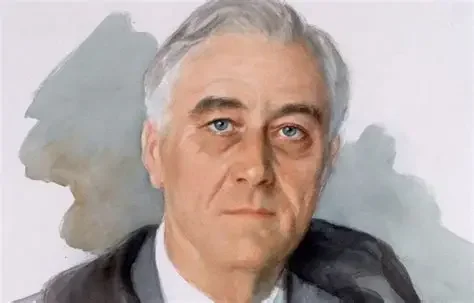
Image: Unfinished watercolor by Elizabeth Shoumatoff, 1945
When Americans think of Franklin Delano Roosevelt, they naturally think of the New Deal, Pearl Harbor, and the Second World War.
Few realize that two decades before entering the White House, Roosevelt was already one of the rising stars of the Wilson Administration.
In 1913, President Woodrow Wilson appointed the thirty-one-year-old Roosevelt as Assistant Secretary of the Navy, the department's second-highest civilian official. It was a position once held by Theodore Roosevelt, a cousin whom Franklin greatly admired.
Although Josephus Daniels served as Secretary of the Navy, Roosevelt immersed himself in the day-to-day administration of America's rapidly expanding naval forces. He traveled extensively, inspected bases and shipyards, worked closely with senior admirals, and became one of Wilson's most energetic and trusted young administrators.
By the closing months of World War I, the United States Navy had become the principal means of transporting American troops, supplies, intelligence personnel, and diplomatic missions across the Atlantic and Pacific Oceans.
No one inside the Navy Department knew those logistics better than Franklin Roosevelt.
As Assistant Secretary, Roosevelt helped coordinate naval operations connecting San Francisco, Vladivostok, and the broader Allied intervention in Siberia. Those same routes would become critically important to the movement of personnel and materials during the American Expeditionary Forces' operations in eastern Russia.
For that reason, Roosevelt occupies an important place in the History Had Eyes investigation.
Throughout his presidency, Woodrow Wilson demonstrated an unusual willingness to entrust significant responsibility to the young Assistant Secretary. Roosevelt's tireless work ethic, organizational ability, political loyalty, and unquestioned discretion made him one of the administration's most dependable rising leaders.
Unlike many political figures of the era, Roosevelt rarely sought public attention for sensitive government operations. He understood that successful military planning often depended upon quiet execution rather than public recognition.
If the Wilson Administration undertook highly confidential activities connected with Siberia - as this investigation explores - Roosevelt would have been uniquely positioned to understand the naval logistics that made such operations possible.
Years later, as President of the United States himself, Roosevelt authored The President's Mystery Story, a fictional tale about an aristocrat who disappears under an assumed identity.
Whether that story reflected nothing more than an imaginative mystery—or whether it subtly echoed experiences from his earlier government service is one of the intriguing questions explored throughout this investigation.
Historian Doris Kearns Goodwin observed that Roosevelt delighted in secrets, surprise, and complicated undertakings known only to a trusted circle.
Perhaps that trait began long before he entered the Oval Office.
Perhaps it began in the Wilson Administration.
FDR Timeline
1913
Appointed Assistant Secretary of the Navy by President Woodrow Wilson.
1917–1918
Helps oversee the rapid wartime expansion of the United States Navy during World War I.
1918–1920
Coordinates naval logistics supporting American operations between San Francisco and Vladivostok during the Allied intervention in Siberia.
1933
Becomes the 32nd President of the United States.
1935–1936
Authors The President's Mystery Story for Liberty magazine.
1936
The story is adapted into the motion picture The President's Mystery.
"Some leaders shape history in public. Others help shape it long before the public ever knows their names."