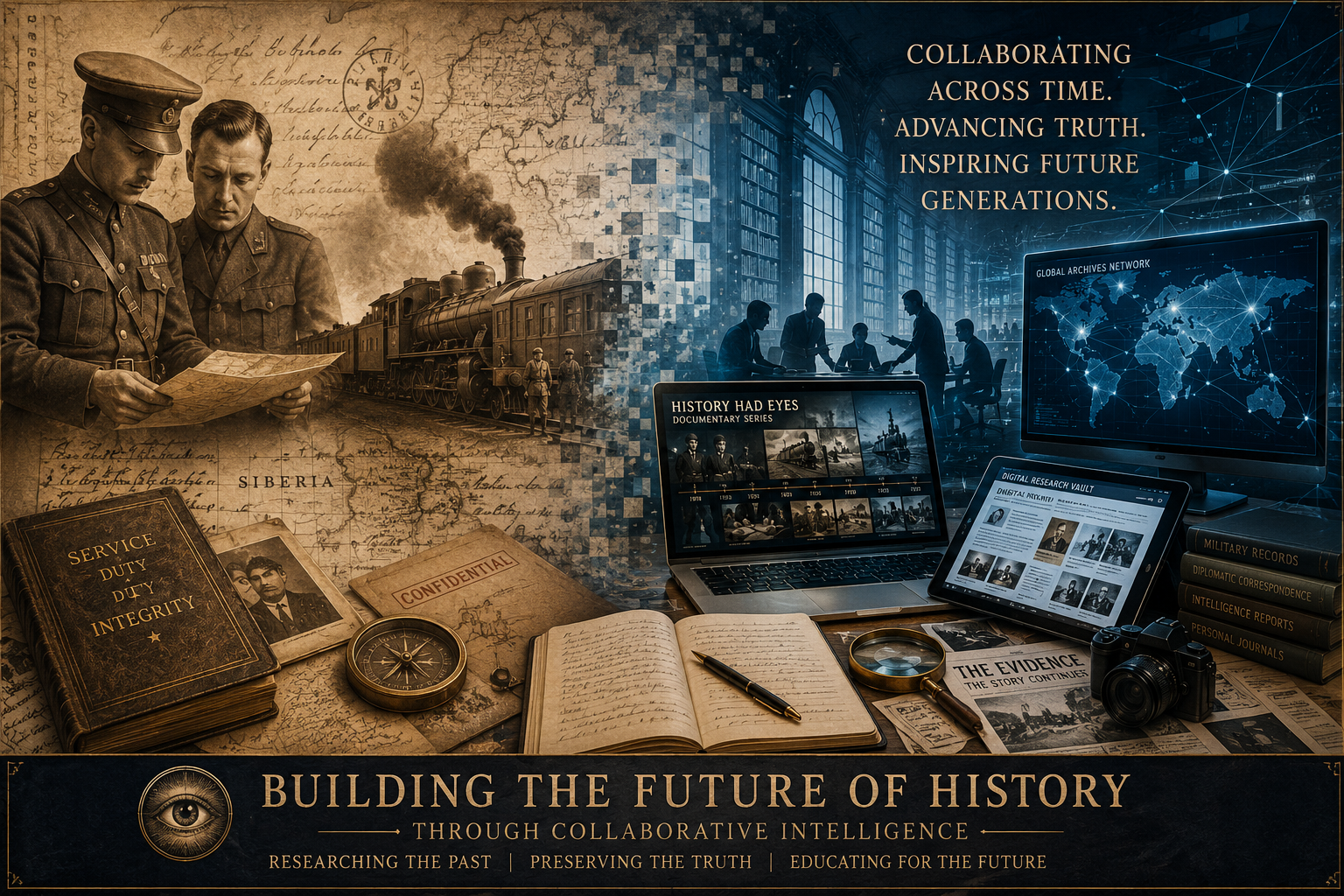
The Hutson Center
Investigating History Can Be Supercharged Through Philanthropic Determination
Beyond One Investigation
History Had Eyes began with a simple question.
Could history still have something important to teach us if we were willing to look again?
What started as a decades-long investigation into one of the twentieth century's greatest historical mysteries has gradually become something much larger. Along the way, historians, archivists, military scholars, researchers, documentary filmmakers, technologists, educators, and curious citizens have contributed ideas, uncovered evidence, challenged assumptions, and demonstrated the extraordinary value of collaborative inquiry.
That journey has revealed an important truth.
The greatest legacy of History Had Eyes may not be the answer to a single historical question. It may be the process by which that answer is pursued.
Throughout history, some of humanity's most significant discoveries have emerged when people from different backgrounds combined their expertise in pursuit of a common goal. Today, modern technology, artificial intelligence, digital archives, documentary storytelling, and unprecedented global access to historical records make that kind of collaboration possible on a scale never before imagined.
History Had Eyes seeks to help lead that next chapter.
Our long-term vision extends beyond books, documentaries, and digital archives. We believe the future of historical investigation lies in creating a permanent interdisciplinary environment where scholars, students, archivists, filmmakers, journalists, technologists, and the public can work together to investigate complex historical questions with intellectual rigor, transparency, and respect for evidence.
This vision has inspired the development of a broader initiative we call Collaborative Intelligence - an emerging approach that brings together expertise from multiple disciplines to discover, preserve, interpret, and communicate history more effectively than any single field can accomplish alone.
In this model, scholarship does not end with publication. Research becomes documentary storytelling. Documentary storytelling becomes public education. Public education inspires new investigations, new discoveries, and new generations of scholars dedicated to the responsible pursuit of truth.
Over time, we hope this vision will grow into a permanent academic and educational enterprise dedicated to advancing Collaborative Intelligence as an enduring field of study and public service. Such an institution would support historical investigations, documentary scholarship, digital preservation, educational innovation, and international collaboration while preparing future generations to investigate the world's most challenging historical questions with integrity and intellectual curiosity.
This is not simply an investment in one investigation.
It is an investment in how future generations investigate history itself.
If you share our belief that the pursuit of truth is strengthened through collaboration, we invite you to follow our journey, explore the evidence, engage with our work, and help shape what comes next.
History has always had eyes.
“Perhaps now, together, we can learn to see more clearly.”
Our Proposed Academic Research Initiative
The Hutson Institute for Collaborative Intelligence Studies
Our University Founding Case Statement | Truth Through Collaboration
Creating the World’s First Academic Institute Dedicated to Collaborative Intelligence
Executive Vision
Throughout history, civilization has advanced because individuals have pursued knowledge with courage, discipline, and intellectual curiosity
Today, however, humanity faces an unprecedented paradox. Never before has so much information been available. Never before has society possessed greater technological capability to investigate the past. Never before have artificial intelligence, digital archives, forensic science, satellite imagery, documentary filmmaking, computational analysis, and global scholarly collaboration offered such extraordinary opportunities to discover historical truth.
Yet public confidence in institutions, scholarship, historical accuracy, and democratic discourse continues to decline.
The challenge confronting universities is no longer simply producing knowledge. It is organizing knowledge. It is integrating disciplines. It is transforming information into trustworthy understanding.
The Hutson Institute for Collaborative Intelligence Studies is proposed to address precisely that challenge.
Rather than establishing another academic center devoted to a single discipline or historical subject, the Institute seeks to establish an entirely new interdisciplinary field dedicated to the collaborative pursuit of truth.
The Defining Question
The Institute is designed to be built around one deceptively simple question:
How should humanity investigate the world’s most difficult historical and public questions in the twenty-first century?
No existing academic discipline answers that question completely.
History contributes. Political science contributes. Government contributes. Artificial intelligence contributes. Intelligence studies contributes. Journalism contributes. Film contributes. Archives contributes. Ethics contributes. But no institution intentionally integrates them into a unified discipline.
The Hutson Institute seeks to become that institution.
The Hutson Brothers Legacy
Every enduring institution begins with a story.
For this Institute, that story begins not with fame or recognition, but with service.
Martin V. Hutson and George R. Hutson accepted responsibilities entrusted to them by leaders they respected, including General John J. “Black Jack” Pershing, Major General William Sidney Graves, and President Woodrow Wilson during one of the most consequential Allied missions of the twentieth century.
Whether viewed through military history, diplomacy, intelligence, or public service, their experiences illustrate a timeless principle.
History is often shaped by individuals whose contributions become visible only when later generations choose to investigate them.
Their legacy, therefore, inspires something larger than historical remembrance. It inspires a disciplined commitment to collaborative inquiry.
The Institute we have planned bears the Hutson name because it seeks to commemorate one family, but because that family’s experience reminds us that truth often emerges through faithful service, careful investigation, and collaboration across generations.
History Had Eyes
History Had Eyes serves as the Institute’s founding demonstration project.
The books, documentary series, digital research vault, educational resources, podcasts, and prospective feature film demonstrate how collaborative intelligence can operate in practice.
The project brings together historians, archivists, military scholars, intelligence professionals, technologists, filmmakers, students, and citizens around one shared commitment: Follow the evidence wherever it leads.
History Had Eyes is therefore not the Institute’s destination. It is its proof of concept.
The methodologies developed through this inaugural investigation will ultimately be applicable to countless historical, governmental, diplomatic, and societal questions.
A New Academic Discipline
Collaborative Intelligence Studies recognizes that complex questions demand organized collaboration among diverse forms of expertise.
The Institute therefore proposes an academic discipline that intentionally integrates:
Historical scholarship.
Political science.
Intelligence studies.
International affairs.
Artificial intelligence.
Documentary scholarship.
Journalism.
Archival science.
Digital preservation.
Ethics.
Public policy.
Constitutional studies.
Museum studies.
Public history.
Strategic communications.
The objective is not interdisciplinary conversation alone. The objective is interdisciplinary discovery.
The Documentary Scholarship Model
One of the Hutson Institute’s defining contributions will be its recognition that scholarship fulfills its highest purpose only when it informs society.
Most research institutes publish important books and journal articles. The Hutson Institute will certainly do the same.
It will also recognize documentary storytelling as a legitimate and rigorous form of scholarly communication.
In partnership with university-based film and media programs, the Institute will establish the Center for Documentary Scholarship, an interdisciplinary enterprise devoted to translating complex academic research into compelling public education.
Faculty historians, filmmakers, journalists, archivists, screenwriters, photographers, museum professionals, and students will work together to produce related documentaries, educational series, feature films, podcasts, museum exhibitions, digital archives, and immersive learning experiences grounded in evidence-based scholarship.
History Had Eyes becomes the inaugural production of this broader academic model. Future investigations – whether focused on diplomatic history, constitutional development, intelligence history, humanitarian crises, or scientific discovery – would similarly benefit from documentary scholarship as a bridge between the academy and the public.
In this model, film is not an ancillary communications tool. It is a scholarly instrument for civic education.
The Seven Founding Laboratories
The Hutson Institute will organize its research through seven permanent laboratories:
1. Historical Intelligence Laboratory.
2. Collaborative Intelligence Laboratory.
3. Artificial Intelligence and Digital Discovery Laboratory.
4. Democratic Intelligence Laboratory.
5. Center for Documentary Scholarship.
6. Global Archives Laboratory.
7. Ethics and Intelligence Laboratory.
Together, these laboratories provide an integrated framework for investigation, discovery, communication, and education.
A Living Academic Enterprise
Unlike many research centers, the Hutson Institute is designed as a continuous cycle of inquiry.
Research generates discoveries. Discoveries generate publications. Publications inspire documentaries. Documentaries generate public engagement. Public engagement attracts new archives, new collaborators, new students, and new philanthropy.
Each stage strengthens the next.
The Hutson Institute becomes a living ecosystem rather than a collection of independent academic activities.
A Deliberate Path to Institutional Excellence
The Hutson Institute is intentionally designed to grow through demonstrated achievement rather than aspiration:
Phase I – The Huston Collaborative Intelligence Initiative: Years 1-2 | The Hutson Initiative functions as a university-affiliated pilot project. Primary objectives include launching the History Had Eyes research program and documentary initiative; populating the Digital Research Vault; forming faculty collaborative collaborations across disciplines; creating the Center for Documentary Scholarship in partnership with a university film and media program; producing peer-reviewed scholarship, documentaries, podcasts, and public lectures; developing the first Collaborative Intelligence curriculum and student fellowships; and securing philanthropic support and validating long-term sustainability. The key milestone is demonstrating scholarly excellence, measurable educational impact, successful interdisciplinary collaboration, and philanthropic viability.
Phase II – The Hutson Center for Collaborative Intelligence Studies: Years 3-5 | Following the successful completion of Phase I, the Initiative matures into a recognized university center. The Center expands to include endowed faculty positions, graduate and undergraduate fellowships, visiting scholars, international archival partnerships, an annual Collaborative Intelligence Summit, professional certificate programs, expanded documentary production, public scholarship initiatives, and a comprehensive Digital Research Vault. The key milestone will be national recognition, sustained philanthropic investment, international partnerships, and a diversified academic portfolio.
Phase III – The Hutson Institute for Collaborative Intelligence Studies: Years 6-10 | Upon achieving sustained academic excellence and financial stability, the Center evolves into a permanent university institute. The Hutson Institute includes endowed executive leadership, multiple endowed chairs, global research laboratories, international research consortia, advanced graduate education, major archival collections, documentary production studios, a permanent exhibition and public engagement facility, and a stable endowment supporting long-term independence and innovation. Institutional designation as an Institute is not the beginning of the journey. It is the recognition of sustained excellence.
The Campaign for Collaborative Intelligence
To realize this vision, the proposed Hutson Institute will undertake a $100 million comprehensive philanthropic campaign organized around mission rather than facilities alone with the following priorities:
Leadership and Governance
Founding Institute Endowment.
Executive Director Chair.
Senior Faculty Chairs.
Leadership Innovation Fund.
Research and Discovery
Seven permanent research laboratories.
The Hutson Project documentary.
AI and Digital Discovery initiatives.
Global Archives partnerships.
Documentary Scholarship and Public Engagement
Center for Documentary Scholarship.
History Had Eyes Studio.
Collaborative Storytelling Studio.
Documentary Production Fund.
Digital Research Vault.
Museum and traveling exhibition initiatives (Special Train #28)
Students and Academic Programs
Collaborative Intelligence Fellows.
Student Investigators Program.
International Scholars Residency.
Summer Institutes.
Professional Certificates.
Doctoral Research Fund.
Global Collaboration
Collaborative Intelligence Summit.
International Research Consortium.
Archive Preservation Initiative.
Public History partnerships.
Long-Term Sustainability
Institute operating endowment.
Innovation and Strategic Opportunities Fund.
Future Questions Initiative.
Technology modernization.
Institutional reserves.
The campaign is designed not merely to fund an institution, but to endow a new field of scholarship for future generations.
An Invitation to Build the Futur
The planned Hutson Institute for Collaborative Intelligence Studies represents more than a proposal for a new academic enterprise. It is an invitation to redefine how universities investigate complex political policy questions, educate future leaders, and communicate knowledge to society.
Inspired by the quiet service of Martin and George Hutson, demonstrated through the History Had Eyes initiative, strengthened through collaborative interdisciplinary scholarship, and shared through documentary storytelling, the proposed Hutson Institute seeks to establish a lasting framework for collaborative intelligence inquiry.
Its enduring legacy will not be measured solely by the questions its answers. It will be measured by the generations of scholars, students, filmmakers, public servants, and citizens it equips to pursue truth together.
For universities, and their donors and stakeholders, opportunities to create a genuinely new discipline are rare.