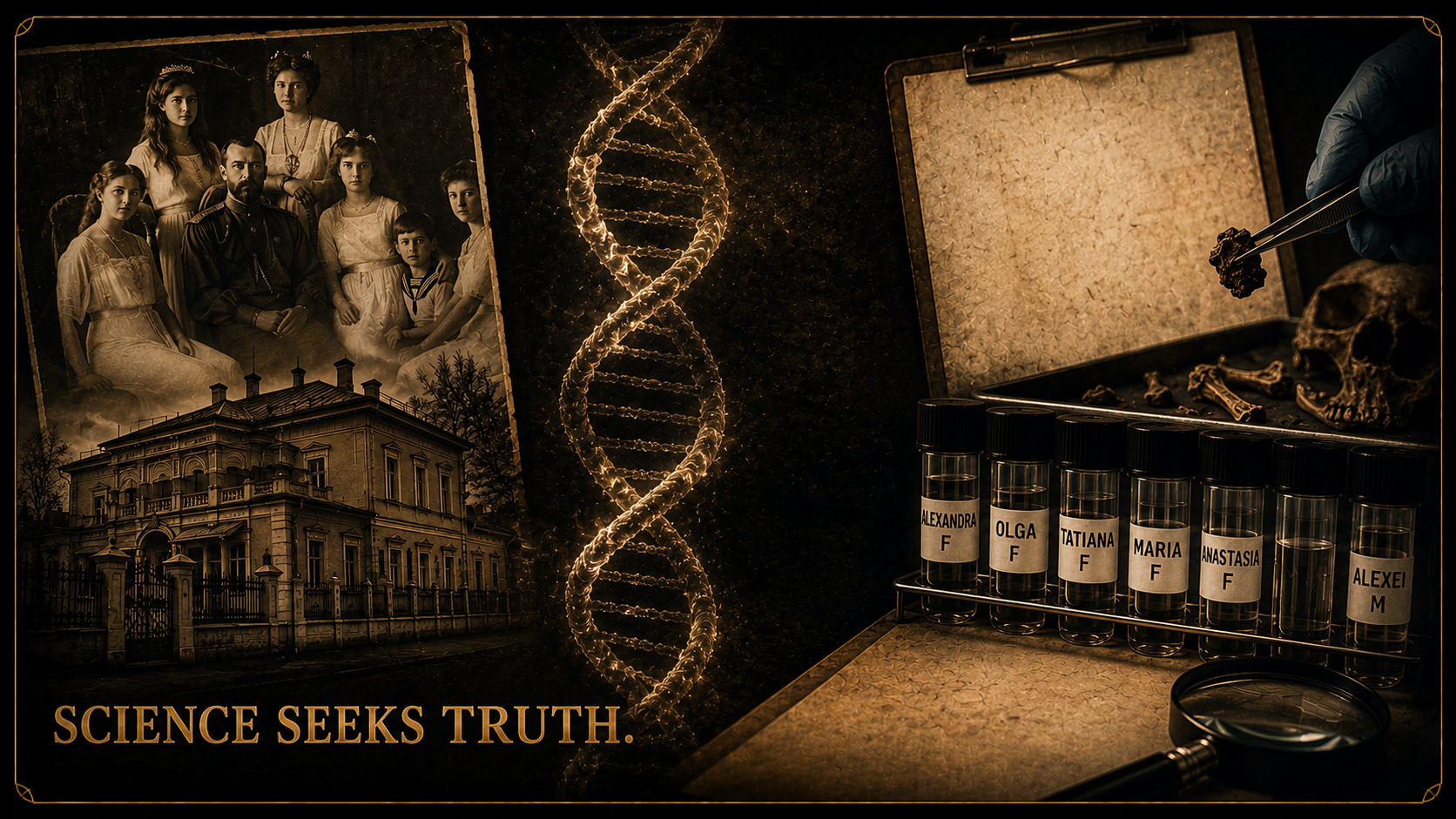
The DNA Controversy
Compromised DNA?
The DNA Question
For many people, the Romanov mystery ended with DNA.
The discovery of skeletal remains near Yekaterinburg in the late twentieth century, followed by DNA testing involving living relatives of the Romanov family, convinced much of the world that Tsar Nicholas II and his family were indeed murdered at the Ipatiev House in July 1918.
Case closed.
Or was it?
The History Had Eyes investigation begins with a different question, not whether DNA is valuable, but whether the evidence presented over the past three decades answers every important scientific question that has been raised.
History advances when evidence is tested.
Science advances when conclusions remain open to new evidence.
Neither advances by discouraging questions.
Dr. William Maples and the Questions He Asked
One of the first internationally recognized forensic anthropologists to examine the Romanov remains was Dr. William R. Maples, professor of anthropology at the University of Florida and one of America's leading forensic scientists.
Dr. Maples did not reject DNA science.
Quite the opposite.
He believed DNA evidence should be interpreted within the broader context of forensic anthropology, skeletal biology, pathology, historical records, and archaeological evidence.
During his examination, Dr. Maples publicly expressed concerns about several aspects of the remains, including observations regarding skeletal characteristics that he believed did not completely correspond with the historical descriptions of members of the Imperial Family.
His position reflected an essential principle of forensic science:
The evidence should determine the conclusion, not the conclusion determine the evidence.
Dr. Maples' questions remain part of the historical record.
Whether later research adequately answered those questions continues to be debated by specialists.
The Russian Orthodox Church's Reservations
The Russian Orthodox Church has likewise approached the Romanov remains with caution.
Although members of the Imperial Family have been canonized as Passion Bearers, Church officials have repeatedly emphasized that questions surrounding the identification of the remains deserve careful scientific and historical review.
Among the issues discussed by researchers are:
The archaeological recovery of the remains;
Documentation of excavation procedures;
Preservation of evidence;
The integrity of the chain of custody;
The identification of comparison samples used for DNA analysis; and
The historical handling of Romanov family burials before, during, and after the Russian Revolution.
These concerns do not automatically invalidate the DNA findings.
They do, however, explain why debate has continued among some historians, scientists, and religious authorities.
Chain of Custody Matters
Every forensic investigation depends upon one fundamental principle:
Can investigators demonstrate that the evidence remained authentic from discovery to laboratory analysis?
If the provenance of samples cannot be established with confidence, forensic scientists naturally ask additional questions.
This is true in modern criminal investigations.
It is equally true when examining historical remains.
Because the Romanov investigation involved discoveries, rediscoveries, reburials, additional excavations, and multiple laboratories over many years, some researchers have argued that every stage of the chain of custody deserves continued scrutiny.
What Evidence Would Change History?
If history is to be revised, extraordinary claims require extraordinary evidence.
Likewise, if existing historical conclusions are to remain persuasive, they should withstand continued examination.
What kinds of evidence could materially strengthen the case that Nicholas II and his immediate family did not die at the Ipatiev House in July 1918?
Among the possibilities are:
Authenticated archival documents demonstrating continued survival after July 1918;
Independently verified military or diplomatic records documenting later custody or movements;
Authenticated photographs or correspondence conclusively dated after 1918;
Forensic evidence directly contradicting the identification of the recovered remains;
Newly discovered biological evidence from securely documented Romanov remains;
Independent DNA analyses using newly authenticated reference samples with an unbroken chain of custody; or
Multiple independent lines of evidence that converge on the same conclusion.
No single piece of evidence would likely be sufficient.
Rather, historians would look for a body of mutually reinforcing evidence from independent sources.
The Purpose of This Investigation
History Had Eyes does not ask viewers to reject forensic science.
Nor does it ask them to disregard DNA evidence.
Instead, it asks a simpler question:
Has every important scientific question been answered?
If the answer is yes, the historical record grows stronger.
If the answer is no, then history - as with all scholarship - should remain open to continued investigation.
That is how science works.
That is how history progresses.
And that is why questions remain worthy of asking.
"DNA is among the most powerful tools in modern science. Like every scientific tool, however, its conclusions are strongest when supported by transparent evidence, rigorous methodology, and the opportunity for independent verification."